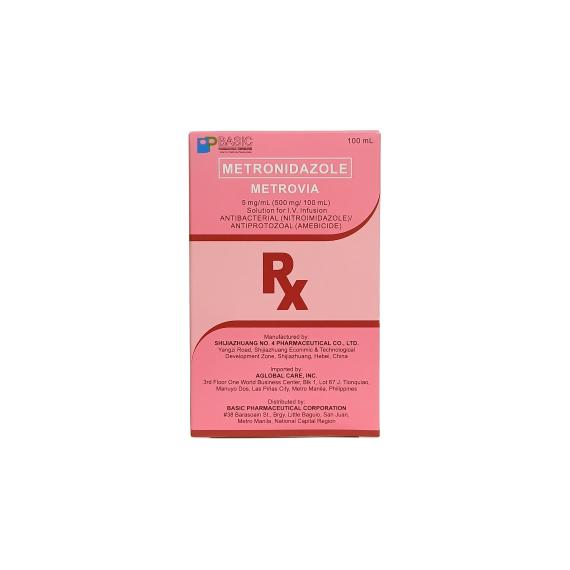
METROVIA SOLUTION FOR I.V. INFUSION 5MG/ML (500MG/100ML)
CAUTION: Foods, Drugs, Devices, and Cosmetics Act prohibit dispensing without a prescription.
THIS IS A PRESCRIPTION DRUG. The contents of this page are provided for information purposes only and should not be a substitute for a professional medical advice or for self-medication. Consult your physician or pharmacist before administration and read all labels prior to use.
METROVIA SOLUTION FOR I.V. INFUSION
Metronidazole .......... 5 mg/mL (500 mg/ 100mL)
ANTIBACTERIAL (NITROIMIDAZOLE) / ANTIPROTOZOAL (AMEBICIDE) | 1 BOTTLE (100 ML) PER BOX
INDICATIONS:
Indicated in adults and children when oral medication is not possible for the following indications:
- The prophylaxis of postoperative infections due to sensitive anaerobic bacteria particularly species of Bacteroides and anaerobic Streptococci, during abdominal, gynaecological gastrointestinal or colorectal surgery which carries a high risk of occurrence of this type of infection. The solution may also be used in combination with an antibiotic active against aerobic bacteria.
- The treatment of severe intraabdominal and gynaecological infections in which sensitive anaerobic bacteria particularly Bacteriodes and anaerobic Streptococci have been identified or are suspected to be the cause.
DOSAGE AND ADMINISTRATION:
Method of Administration
Metronidazole 500mg/100mL Intravenous Infusion should be infused intravenously at an approximate rate of 5mL/minute (or one bag infused over 20 to 60 minutes). Oral medication should be substituted as soon as feasible.
Prophylaxis against postoperative infections caused by anaerobic bacteria:
Primarily in the context of abdominal, (especially colorectal) and gynaecological surgery.
Antibiotic prophylaxis duration should be short, mostly limited to the post operative period (24 hours but never more than 48 hours). Various schedules are possible.
Adults: Intra-venous injection of single dose of 100mg-1500mg, 60-60 minutes preoperatively or alternatively 500mg immediately before, during or after operation, then 500mg 8 hourly.
Children < 12 years: 20-30 mg/kg as a single dose given 1-2 hours before surgery.
Newborns with a gestation age <40 weeks: 10 mg/kg body weight as a single dose before operation.
Anaerobic infections:
Intravenous route is to be used initially if patient symptoms preclude oral therapy. Various schedules are possible.
Adults: 1000mg-1500mg daily as a single dose or alternatively 500mg every 8 hours.
Children <8 weeks to 12 years of age: The usual daily dose is 20-30mg/kg/day as a single dose or divided into 7.5 mg/kg every 8 hours. The daily dose may be increased to 40 mg/kg, depending in the severity of the infections. Duration of treatment is usually 7 days.
Children < weeks of age: 15 mg/kg as a single dose daily or divided into 7.5 mg/kg every 12 hours.
In newborns with a gestation age <40 weeks, accumulation of metronidazole in serum should preferably be monitored after a few days of therapy
Oral medication could be given, at the same dose regimen. Oral medication should be substituted as soon as feasible.
Duration of Treatment
Treatment for seven to ten days should be satisfactory for most patients but, depending upon clinical and bacteriological assessments, the physician might decide to prolong treatment e.g.: for the eradication of infection from sites which cannot be drained or are liable to endogenous recontamination by anaerobic pathogens from the gut, oropharynx or genital tract.
Bacterial vaginosis:
Adolescents: 400 mg twice daily for 5-7 days or 2000 mg as a single dose
Urogenital trichomoniasis:
Adults and adolescents: 2000 mg as a single dose or 200 mg 2 times daily for 7 days or 400 mg twice daily for 5-7 days
Children <10 years: 40 mg/kg orally as a single dose of 15-30 mg/kg/day divided in 2-3 doses for 7 days; not to exceed 2000 mg/dose
Giardiasis:
>10 years: 2000 mg once daily for 3 days, or 400 mg three times daily for 5 days, or 500 mg twice daily for 7 to 10 days
Children 7 to 10 years: 200 to 400 mg 3 times daily for 5-10 days
Children 3 to 7 years: 100 to 200 mg 4 times daily for 5-10 days
Children 1 to 3 years: 100 mg to 200 mg 3 times daily for 5-10 days
Alternatively, as expressed in mg per kg of body weight: 15-40 mg/kg/day divided in 2-3 doses.
Amoebiasis
>10 years: 400 to 800 mg 3 times daily for 5-10 days
Children 7 to 10 years: 200 to 400 mg 3 tiomes daily for 5-10days
Children 3 to 7 years: 100 to 200 mg 4 times daily for 5-10 days
Children 1 to 3 years: 100 mg to 200 mg 3 times daily for 5-10 days
Alternatively, doses may be expressed by body weight 35 to 50 mg/kg daily 3 divided doses for 5 to 10 days, not to exceed 2400 mg/day
Eradication of Helicobacter pylori in paediatric patients:
As a part of a combination therapy, 20 mg/kg/day not to exceed 500 mg twice daily for 7-14 days.
Official guidelines should be consulted before initiating therapy
Elderly Population
Caution is advised in the elderly, particularly at high doses, although there is limited information available on modification of dosage.
Patients with renal failure
Routine adjustment of the dosage of Metronidazole are not considered necessary in the presence of renal failure,
No routine adjustments of the dosage of Metronidazole needs to be made in patients with renal failure undergoing intermittent peritoneal dialysis (IDP) or continuous ambulatory peritoneal dialysis (CAPD). However dosage reduction may be necessary when excessive concentrations of metabolites are found.
In patients undergoing haemodialysis, Metronidazole should be re-administered immediately after hemodialysis.
Patients with advanced hepatic insufficiency
In patients with advanced hepatic inefficiency a dosage reduction with serum level monitoring is necessary.
Follow us on: